
 Status:
 Design

 Contact:
 mb8@manybabies.org
Listserv: Subscribe
 223 authors from 53 countries on PsyArXiv preprint
Missed the launch events? View the recording and slides
Book a meeting to discuss the project with a project lead
If you would like to join MB8, please contact the project leads
Young children begin interacting with digital media within the first months of life, yet research on early digital media use remains limited in scope and comparability. Existing evidence is overwhelmingly based on WEIRD populations (Western, Educated, Industrialized, Rich, and Democratic; see Henrich, 2024) / Minority world, leaving major gaps in our understanding of how very young children engage with digital media in non-WEIRD contexts, where cultural norms, economic conditions, and caregiving practices may differ substantially. This lack of global diversity limits the generalizability of existing findings and makes it difficult to understand how contextual factors shape the relationship between digital media use and child development. Moreover, the use of diverse, non-standardized assessment tools further hinders meaningful comparisons across studies and countries.
The MB8 project addresses these gaps by examining cross-country variation in young children's digital media use and investigating how early media experiences relate to language and socio-emotional development across diverse cultural and socioeconomic contexts. By adopting a common methodology and standardized measures, MB8 aims to establish a unified and accessible approach to data collection that will benefit researchers studying child media use as well as developmental scientists more broadly.
The study will recruit families of children aged 6 to 36 months using a common research protocol translated and culturally adapted across participating countries. Parents will complete a standardized online survey incorporating validated measures of children's digital media experiences, including media quality, joint media engagement with caregivers, and parental attitudes and motivations regarding media use (Media Assessment Questionnaire v2; Barr et al., 2024), as well as family characteristics (Singh et al., 2024), children's language development (MacArthur-Bates Communicative Development Inventory; Fenson et al., 1994), and socio-emotional development (BITSEA; Briggs-Gowan & Carter, 2004). The use of shared procedures and validated instruments across sites will enable direct comparisons across diverse cultural and socioeconomic settings.
Beyond documenting children's digital media use globally, MB8 seeks to address several fundamental questions: How much screen media are young children exposed to across countries? How do family characteristics, cultural practices, and national contexts shape children's digital environments? Which aspects of media use—such as co-viewing with caregivers, parental motivations, and media content—are consistently associated with developmental outcomes across cultures, and which are context-specific? Addressing these questions is essential for moving beyond simplistic measures of "screen time" toward a more nuanced understanding of children's digital media experiences. Ultimately, MB8 will establish an enduring international research infrastructure and an openly accessible scientific resource for the developmental science community. By generating a comprehensive global evidence base on young children's digital media experiences, the project aims to support more equitable, culturally informed, and evidence-based recommendations for families, practitioners, and policymakers worldwide.
Project timeline and status (updated mid-2026)
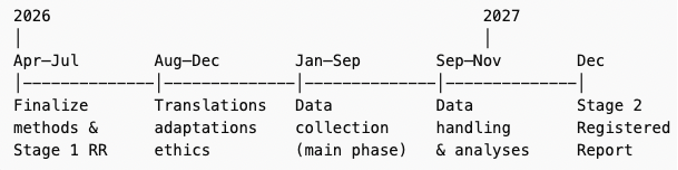
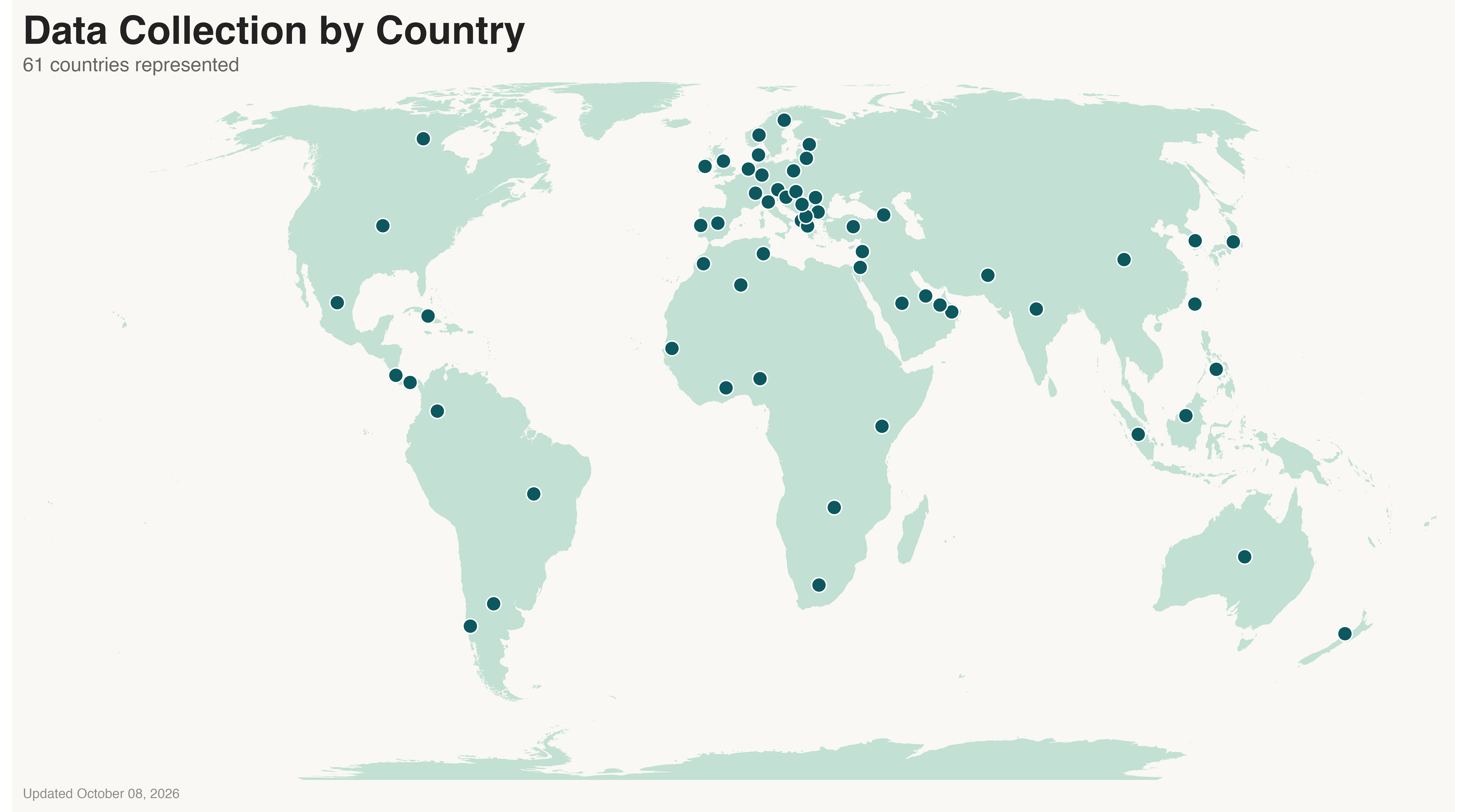
MB8 comprises nearly 400 members and more than 150 data collection sites across approximately 60 countries. The project continues to expand its international network, with a particular focus on increasing representation from currently underrepresented regions. Researchers and research teams from countries not yet represented in MB8 are warmly encouraged to join the project!
MB8 data collection countries (planned)
Project Leads
-
Nevena Dimitrova, University of Applied Sciences and Arts of Western Switzerland (HETSL | HES-SO)
 [email]
-
Rachel Barr, Georgetown University [email]
-
Sarah C. Kucker, Southern Methodist University [email]
-
Joscelin Rocha-Hidalgo, The Pennsylvania State University [email]
MB8 Contributors
NOTE: Default table ordering is by contributor's first name or by publication author order. You can filter, group, and/or sort entries by any field.
Project contributors can update/add info to the MB Dashboard using this form
Publications
View full author list
Sarah C. Kucker
Joscelin Rocha-Hidalgo
Koeun Choi
Lucas Gustavo Gago-Galvagno
Elizabeth J. Goldman
Louisa Kulke
Lauren Myers
Sarah Pila-Leiderman
Catarina Vales
Ensar Acem
Margaret Addabbo
Asli Aktan-Erciyes
Laila Al Salmi
Pilar Alamos
Adeola F. Alao
Haifa Alroqi
Muna Salim AL-Siyabi
Burcu Altin
Nicole Altvater-Mackensen
Krystal Alvarez-Hernandez
Natalia Arias-Trejo
Emma L. Axelsson
David Barnstone
Mihaela D. Barokova
Oumar Barry
Tamara Bastianello
Heidi A. Baumgartner
Marina Bazhydai
Debora Becker
Francesca Bellagamba
Silvia Benavides-Varela
Ilene R. Berson
Mitali Bhavsar
Adina C. Bleotu
McCall A. Booth
Rita Brito
Mary E. Brushe
Julius Burkauskas
Niccolò Butti
Krista Byers-Heinlein
Zenobia Calhoun
Erin E. Campbell
Chiara Cantiani
Annalyn De Guzman Capulong
Ana M. Carmiol
Melis Çetinçelik
Konstantine Chakhunashvili
Kin Chung Jacky Chan
Chien-Ju Chang
Mohamed-Souhaiel Chelly
Xiaoyun Chen
Yun Jung Choi
Fatmanur Cifci
Tobias Constien
Elisabetta Conte
Andrea Czakó
Catherine Davies
Zsolt Demetrovics
İbrahim Demirci
Antonia Dinzinger
Yatma Diop
Matias Dodel
Hicran Doğru
Jasmin Dönicke
Rebecca A. Dore
Michelle Downes
Angel Belle C. Dy
Stanka A. Fitneva
Jade H. Y. Fok
Frankie T. K. Fong
Samuel H. Forbes
Giana Bitencourt Frizzo
Daniela Galvez-Cepeda
Rowena Garcia
Megan Gath
Hila Gendler Shalev
Neda Ghassemi
Nishanth Ghaty
Katie A. Gilligan-Lee
Juan J. Giraldo-Huertas
Biljana Gjoneska
Lisa Golds
Nayeli Gonzalez-Gomez
Gustaf Gredebäck
Annalisa Guarini
Fernanda Pinto Monteiro Guimarães
Naziye Güneş Acar
Mahmut Sami Gürdal
İlke N. Güven
Oh-Ryeong Ha
J. Kiley Hamlin
Adriana Hanulikova
Madeline Harms
Rabia Hassan
Naomi Havron
Jessica S. Horst
Lauren H. Howard
Lingyan Hu
Xuechun Huang
Sabine Hunnius
Yağmur İlgün
Yu Ishii
Jemima S. Jacob
Alejandra Jáuregui
N Kacem
Junko Kanero
Palak Kanwar
Natalia Kartushina
Jordy Kaufman
Caroline Kelsey
Justina Kievišienė
Eon-Suk Ko
Shannon P. Kong
Veronika Konok
Carolin Konrad
Maja Korubin Kjorluka
Marina Kotria Topic
Marta Kowal
Peter Krøjgaard
Ksenija Krstic
Valentina Lucia La Rosa
Alesha Lamont
Letícia Carvalho Leão
Saein Lee
Jaroslaw R. Lelonkiewicz
Casey Lew-Williams
Chaolan Lin
Liquan Liu
Diana C. Lopera-Perez
Maíra Lopes Almeida
Megan G. Lorenz
Irena Lovčević
Nivedita Mani
Silvana Mareva
Clarice Martins
Eleanora Mascheroni
Gina Marie Mason
Magda Matetovici
Siva Mathiyazhagan
Julien Mayor
Brandon T. McDaniel
Dean P. McDonnell
Katharina H. Menn
Marlene Meyer
Stephanie Miller
Mayilin Moreno-Torres
Veronica Muffato
Sarah Nazzari
Thierry Nazzi
Mikateko Ndhambi
Delphine Kim-Linh Nguyen
Ekaterina Novikova
Shally Novita
Cátia M. Oliveira
Paul Okyere Omane
Rose A. Opiyo
Adebunmi O. Oyekola
Meryem Seyda Ozcan
Asli Ali Özdoğru
Zeynep Özdoğru
Beyza Öztaylan
Anna Parenteau
Chaewon Park
Meredith Pecukonis
Duygu Pekel
Mathilde H. Prenevost
Laiana Quagliato
Yaser Ramírez Benítez
Peter J. Reschke
Valentina Riva
Tanja C. Roembke
Mónica Rojas-Morera
Audun Rosslund
Ronit Roth-Hanania
Caroline F. Rowland
Brooke Ryan
Gizem Samdan
Noelia Sánchez-Pérez
Alessandra Sansavini
Burcu Sarı Uğurlu
Ayumi Sato
Koichi Sato
Joëlle A. M. Schroën
Lidia Scifo
Rinanda R. A. Shaleha
Jeanne L. Shinskey
Yuta Shinya
Mônia Aparecida da Silva
Cynthia L. Smith
Jonathan Smith
Tineke M. Snijders
Trine Sonne
Piotr Sorokowski
Radhika Srivastava
Jessica N. Steil
Bolim Suh
Annette S. Sundqvist
Chiara Suttora
Edyta A. Swider-Cios
Cara S. Swit
Alvin Wei Ming Tan
Gemma Taylor
Kashyapi Thakuria
Jaan Tulviste
Tiia Tulviste
Emmanuel Udofia
Berna A. Uzundağ
Anika van der Klis
Sophia Vinci-Booher
Antje von Suchodoletz
Gert Westermann
Kali Woodruff Carr
Amanda Mae Woodward
Yunyi Wu
Yan Linlin
Chen Yang
Merve Yılmaz-Karataş
Francis L. Yuen
Henriette Zeidler
Maria Zia
Hussein Ziab
Rachel Barr